
Meet the AGILE Framework: A Cross-Sector Solution for Modern Organizational Strain
Let me know if any of this sounds familiar.
A well-known retail brand spent months caught in the middle of opposing public expectations for its inclusion strategy. During a routine company town hall, its own employees admitted that no one could clearly define what “diversity and inclusion” meant for their day-to-day work. At the same time, a major health system lost a wave of nurses just when new equity and quality regulations took effect, leaving leadership scrambling to address compliance, staffing shortages, and patient care—all without a unified plan. Across the sector, a global firm found itself in the headlines not for innovation but for inconsistency after an internal memo surfaced. In yet another case, a technology company rolled out an AI workflow tool only to discover it widened existing disparities because no one had evaluated how it would reshape workloads. Different industries, similar breakdowns. The common thread: organizations reacting faster than they can coordinate, absorbing risks they did not foresee, working within systems that were never designed for today’s complexity.
Organizations now navigate turbulent markets, shifting public agendas, evolving workforce expectations, and rapid technological change all at once. Stakeholders demand fairness and clarity even as business conditions shift without warning. Meanwhile, institutions continue to rely on fragmented approaches: Diversity, equity, and inclusion (DEI) efforts that stand apart from strategic planning, governance models focused on compliance rather than stewardship and legacy change processes that ignore human experience. Those splits erode credibility, undermine operational clarity, and steer organizations slowly off course—even when the mission remains intact.
More than goodwill and good intentions are required to meet this moment. What organizations need is an operating system designed for complexity—one that helps leaders see ahead, bind purpose to practice, and evolve consistently over time. That is the role of the AGILE Framework, and as a special holiday gift to leaders navigating these challenges, I am sharing it with you here as #FreeGame. This month’s issue provides a high‑level overview of the AGILE Framework, introducing its core components. Consider this little present as a thank you for rocking with me for the entire year, and a tool to start the new year with clarity, readiness, and purpose.
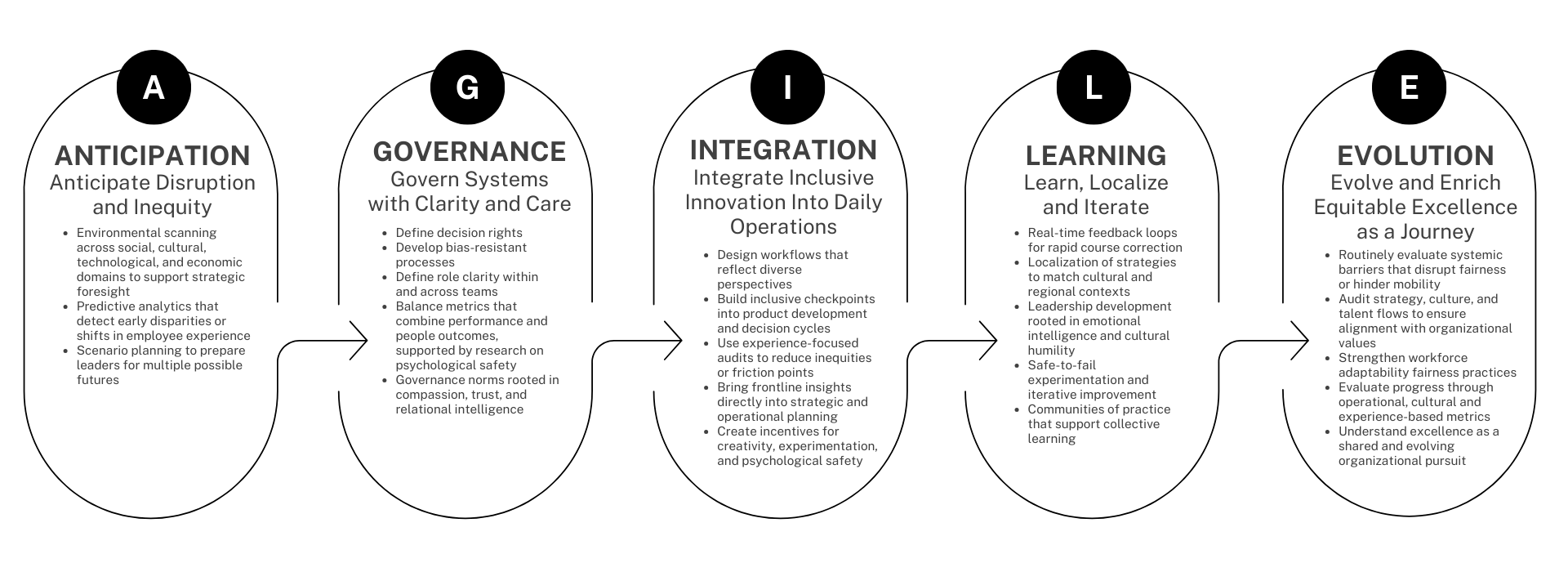
AGILE Framework by Dr. Brandon L. Wolfe
(A)nticipation — Anticipate Disruption and Inequity
Organizations often struggle not because conditions are unpredictable, but because they are unprepared. AGILE encourages structured anticipation using environmental scanning, predictive insights, and scenario planning. Leaders can spot potential disparities before they escalate and align responses with strategy and operational priorities. Assessing internal dynamics as part of this process also helps prevent inequities and build trust, while improving organizational readiness for change.
(G)overnance — Govern Systems With Clarity and Care
AGILE approaches governance as a system that provides clear roles, responsibilities, and decision-making pathways. By embedding accountability and fairness into everyday operations, organizations reduce confusion, empower teams, and maintain alignment with their mission. Governance under AGILE is practical: it guides resource allocation, prioritizes initiatives, and ensures decisions support both operational effectiveness and equity.
(I)ntegration — Embed Inclusive Innovation in Daily Operations
Inclusion only has value when it is part of how work gets done. AGILE integrates inclusive practices into workflows, projects, and planning cycles. By doing this, organizations ensure that diverse perspectives shape outcomes, improve innovation, and strengthen engagement. Integration also means aligning processes, technology, and metrics to make equitable participation part of routine operations rather than an occasional program.
(L)earning — Learn, Localize, and Iterate
Learning is continuous and embedded in daily work. AGILE promotes feedback loops, leader development, localized strategy, and safe experimentation. Teams can test ideas, gather lessons, and iterate without creating enterprise-wide risk. This approach builds adaptive capacity and resilience, turning disruption into an opportunity to improve outcomes.
(E)volution — Evolve and Enrich Equitable Excellence as a Journey
Equity and excellence are ongoing priorities, not milestones. AGILE emphasizes monitoring outcomes, adjusting practices, and embedding lessons into systems. Organizations using this approach strengthen trust, support talent mobility, and maintain mission alignment while evolving. By making equity a consistent operational focus, institutions sustain performance and innovation over the long term.
Why AGILE Matters Now
Many institutions operate in silos where strategy is disconnected from people, governance is divorced from wellbeing, and DEI is treated as a compliance checkbox or public relations add-on. AGILE dismantles those silos. It establishes a shared language for organizational maturity, aligns equity with agility, accountability with operational rigor, and purpose with execution.
Able to scale across sectors, organizations that adopt AGILE gain deeper internal trust, more resilient operations, greater credibility with stakeholders, and higher capacity for innovation and impact. In a moment defined by disruption and uncertainty, AGILE offers a coherent path forward.
Thanks for reading! I’d love to hear your thoughts on this article. Did I miss anything? Do you have personal experiences or observations to add? Let me know! As always, I hope this helps! ✌🏾 + 🫶🏾
Footnotes is a newsletter dedicated to exploring insights, trends, and strategies to help leaders navigate change and future-proof their organizations. It is also a platform where I share ideas that encourage thoughtful dialogue. Your feedback is always valued. The views expressed here are solely my own and do not represent those of any affiliated organizations. Thank you for reading and engaging with this work.
